
Sade Traditional Village Rises Following the Fire, Sasak Traditional Houses and Customs Remain Protected.
Wednesday, 14 October 2026 | 15:30
Author: Arif S

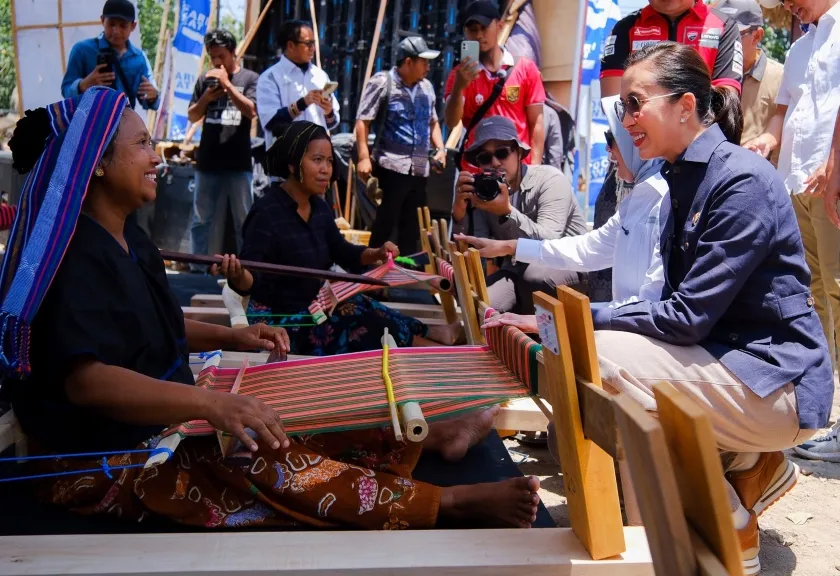
Sade Traditional Village in Central Lombok, West Nusa Tenggara (NTB) is currently undergoing recovery after a fire on 22 August 2026 damaged the traditional settlement area. Rehabilitation efforts do not only focus on rebuilding affected buildings, but also on ensuring the preservation of Sasak community traditions, improving environmental safety, and restarting local residents' economic activities.
Minister of Tourism Widiyanti Putri Wardhana inspected the rehabilitation progress of Sade Traditional Village on 11 October 2026. During this visit, the Tourism Minister emphasized that recovery works must preserve the authenticity of traditional house architecture while strengthening fire risk protection measures.
"Our principle is clear: we will rebuild Sade Traditional Village to be safer and more resilient, without sacrificing the authenticity of its architecture and the traditional values that define its identity," stated Minister Widiyanti.
READ ALSO
78.2% Still Pioneering, Gov't Boosts Tourist Village Transformation
Sade Begins Recovering, the Ministry of Tourism Provides Working Capital Assistance for MSMEs as well as Tourism Promotion Support.
Mount Anak Krakatau Eruption: These are the Ministry of Tourism's Steps to Protect Tourists and Destinations
For the people of Sade, traditional houses, settlement spatial layout, weaving crafts, and ancestral traditions are integrated parts of daily life as well as core Cultural Tourism attractions. For this reason, reconstruction works must run in parallel with efforts to safeguard the local community's identity.
Widiyanti emphasized that the impact of the fire cannot be measured solely by material losses. Recovery must also cover social life, livelihoods, and the Cultural Heritage that has long formed a vital foundation of Sade's tourism industry.
"For us, these numbers do not only represent physical damages. There are people's lives, economic activities, and cultural heritage that we must restore all at the same time," the Minister added.
Reconstruction Commences With Traditional Ritual
Reconstruction works for Sade Traditional Village officially began on 3 September 2026. The first phase was marked by the Nyemulak (Tanjak Teken) traditional ritual, which symbolizes the collective start of reconstruction works alongside all partner stakeholders.
Construction is prioritized for community social and cultural facilities. Works started with the village mosque, followed by sekenam (communal gathering spaces), a semi-permanent museum, and proper sanitary bathroom and toilet facilities.
Subsequent phases will cover full reconstruction of the entire settlement area, while retaining the characteristic traditional house architecture, historic settlement layout, and the Sasak community's traditional way of life.
However, preserving the authenticity of the village does not mean compromising on safety. The government is also mandating installation of fire protection systems, designated evacuation routes, reliable water supply infrastructure, firefighting equipment, improved sanitation, and other emergency response facilities.
Through these measures, Sade Traditional Village is expected to become a cultural tourism destination that is not only authentic and attractive, but also safe and comfortable for both local residents and visiting tourists.
Rp 817.5 Million Aid To Revive Local Community Economy
Alongside physical reconstruction, restoring local residents' income is a top priority for the Ministry of Tourism. Local residents must be able to resume their livelihoods without waiting for the entire reconstruction process to be completed.
To support this goal, the Ministry of Tourism has distributed Business capital grants and work equipment with a total value of Rp 817.5 million.
This assistance includes 15 units of gedogan traditional looms, working capital for 69 Micro, Small and Medium Enterprises (MSMEs), 70 packages of weaving raw materials, and 43 equipment packages for non-weaving handicrafts.
This support is designed to help weavers, artisans, and MSME operators resume production, market their goods, and earn daily income throughout the recovery period.
For the Sasak community, weaving is far more than just an economically valuable craft. Its patterns and production methods also represent cultural identity and indigenous knowledge passed down through generations.
During her village inspection, Widiyanti spoke with Ina Aris, one of the resident weavers of Sade Traditional Village. Ina expressed her hope that Tourist Visits would bring greater tangible benefits for local artisans.
"Sade weaving patterns have very unique, distinct characteristics. I hope that tourists visiting Sade Village will not only admire the beauty of the village, but also learn about the weaving process and purchase local products. This way, Sade weaving will become better known, remain preserved, and bring economic benefits to our community," Ina stated.
This hope aligns with efforts to develop tourism as a sustainable livelihood source for local communities. Tourists will not only visit to view traditional houses and village atmosphere, but will also have the opportunity to learn the weaving process and purchase goods directly from the artisans.
In this way, tourism activities can provide direct economic benefits while also helping to preserve the Sasak community's traditional skills.
Indigenous Community As The Lead Actors In Recovery
Widiyanti confirmed that the indigenous community must be involved at every stage of rehabilitation. Community participation is required to ensure reconstruction works respect traditional values, retain local wisdom, and address the actual needs of residents.
The Ministry of Tourism has also prepared training programs to improve residents' capacity in managing tourism and culture-based creative enterprises.
These programs include skills upgrading for local tour guides, implementation of safety and service standards, handicraft product catalog updates, product identity strengthening through branding, and digital marketing training to access wider markets.
The government is also preparing for the official relaunch of Sade Traditional Village as a cultural tourism destination.
The relaunch timeline will be determined based on community readiness, completion of supporting facilities, and fulfilment of safety standards to ensure safe, comfortable visits for tourists.
During her visit, Widiyanti inspected Sade Museum alongside the curator of the West Nusa Tenggara State Museum, and tested the village's new virtual tour facility developed with support from the Lombok Tourism Polytechnic.
Implementation of this digital technology is one of the measures designed to enrich tourist experiences and expand public access to Sasak cultural heritage.
Recovering Without Losing Cultural Identity
The recovery of Sade Traditional Village is being carried out through collaboration between central and regional government, the indigenous community, and strategic partners. During the inspection visit, Widiyanti was accompanied by Ministry of Tourism officials, with representatives from the regional government and PT Amerta Indah Otsuka also in attendance to provide support.
Endap, Head of Sade Traditional Hamlet, expressed gratitude for the attention and assistance provided to the community throughout the recovery process.
"For us, Sade is not just a tourism destination. This is the home for the ancestral culture and traditions that we are obliged to protect. We hope that support from the Minister and all parties will help speed up Sade's recovery, so our people can return to their activities and our traditions will remain preserved," Endap stated.
For the people of Sade, successful recovery does not only mean rebuilding damaged structures. Most importantly, it means that residents can resume their lives, retain their traditions, and earn an income through economic activities and tourism.
Widiyanti emphasized that cross-party collaboration must continue until the benefits of recovery are fully felt by every member of the community.
"We will not measure success only by how many buildings have been rebuilt. True success is when our people are empowered once again, when culture remains alive, when the economy runs again, and when tourists can visit safely," the Minister concluded.








Belum ada komentar. Jadilah yang pertama!